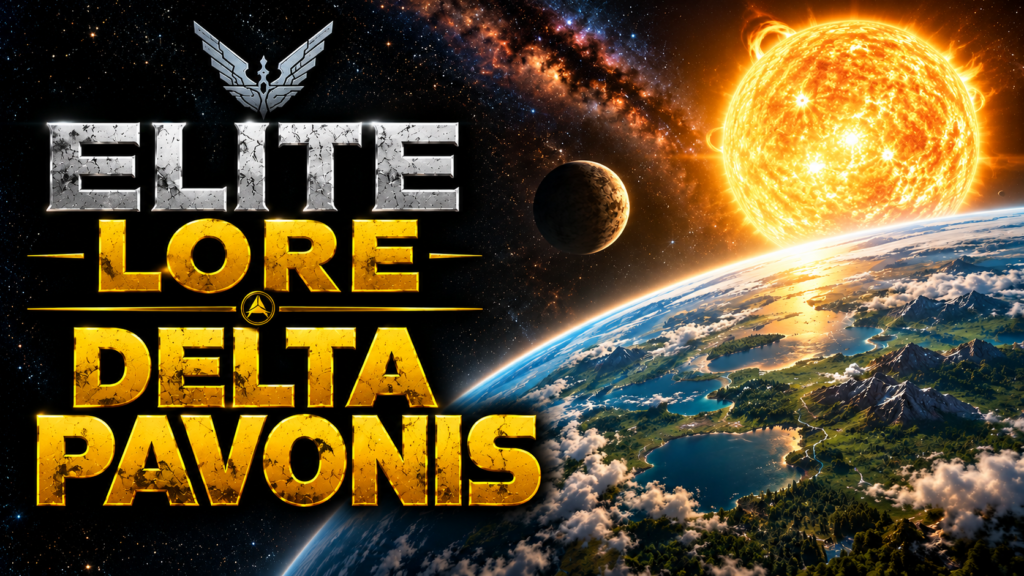
Delta Pavonis is one of the nearest stellar systems to Sol and among the most significant worlds in the history of human expansion. Located approximately 19.9 light-years from Earth in the constellation Pavo, the system is centered around a yellow subgiant star of spectral class G8 IV. Slightly larger, older, and more luminous than Sol, Delta Pavonis has long attracted scientific interest because of its high metallicity, stable nature, and strong potential for planetary formation. Its age is estimated at over six billion years, making it somewhat older than humanity’s home star.
The star emits approximately twenty-four percent more energy than Sol and is believed to be approaching the later stages of its main-sequence lifetime. Despite this gradual evolution, Delta Pavonis has remained stable enough to support a complex planetary system over geological timescales. Its abundance of heavy elements contributed to the formation of numerous planetary bodies and ultimately made the system an attractive target for early interstellar exploration.
Human explorers arrived in Delta Pavonis during the first great wave of extrasolar colonization in the late twenty-second century. Survey teams discovered a system rich in resources and home to one of humanity’s earliest encounters with extraterrestrial life. Primitive indigenous organisms were identified on the world later known as Reagan’s Legacy, providing the first confirmation that life had arisen independently beyond Earth.
The system’s history was also marked by tragedy. Contact between terrestrial microorganisms and the native biosphere resulted in an ecological catastrophe that ultimately led to the extinction of the indigenous life forms. The event became one of the defining environmental lessons of the early colonial era and influenced planetary protection policies for centuries afterward.
Following extensive settlement and terraforming efforts, Reagan’s Legacy was transformed into a habitable world capable of supporting a large permanent population. Over time, it developed into one of the principal centers of human civilization beyond Sol. Its cities, industries, and research institutions played an important role in the economic and political development of the surrounding region.
By 2242, Delta Pavonis had become one of the five founding systems of the Federation, alongside Sol, Tau Ceti, Altair, and Beta Hydri. The system’s strategic position, economic strength, and historical significance ensured its place among the most influential worlds of the early interstellar age.
Today, Delta Pavonis remains one of humanity’s most respected and historic systems. Known for its pioneering role in the First Human Diaspora, its contributions to science and exploration, and the enduring legacy of Reagan’s Legacy, the system stands as a symbol of both the achievements and responsibilities that accompanied humankind’s expansion among the stars.
Habitable Planet Discovery
As John Taylor’s policies were implemented in the Tau Ceti Taylor Colony, some political groups could not accept the new self-governance and set out to discover and move to a new world.
In 2180, hyperspace probes were sent to several star systems, including Delta Pavonis. Unfortunately, the atmosphere of Delta Pavonis 3 required adaptation before humans could live there. Political disagreements and direct hostility forced opponents of John Taylor’s policies to move to Delta Pavonis 3, as it was literally the next world over.
The probe data were as follows: surface pressure, 6.75 atmospheres; surface temperature, 318–319 K (approximately 45–46°C); oxygen, 18%; nitrogen, 81.6%; argon, 0.3%; and carbon dioxide, 0.1%.
The planet’s equatorial regions turned out to be scorched, much like Taylor’s Colony. However, the polar regions had a moderate climate and good soil suitable for farming. Overall, the planet appeared very promising for industrial expansion, as it had enormous deposits of iron, coal, aluminum, ilmenite, and rutile.
The first probes also returned data about life on Delta Pavonis 3. In 2182, fragile indigenous life, still at an early stage of its evolution, was discovered on the planet and completely wiped out by a bacteriological accident in the same year. It was not intelligent life. No evidence of cities, technology, or civilization was found.
The disappearance of Delta Pavonis 3’s indigenous life demonstrated that humanity could not simply arrive on a distant world and claim it as its own. We had already failed twice in a row, and many feared that sooner or later we would do it again.
The Delta Pavonis Colonization
What the first settlers on Delta Pavonis 3, or Reagan’s Legacy, encountered was a lush and beautiful paradise—with one unusual feature. Its vast, seemingly endless forests had enriched the atmosphere with unusually high concentrations of oxygen. With an atmospheric pressure of 6.75 atmospheres and an oxygen concentration of 18 percent, the planet presented a constant fire hazard.
Objects did not spontaneously burst into flames, but even minor sparks could ignite dust, dried organic matter, or other combustible materials. Every colonist carried a fire extinguisher, and reports of smoldering equipment, storage facilities, and supply depots were common during the early years of settlement.
The protective suits imported from Tau Ceti were made from fire-resistant materials. Unfortunately, this offered only limited protection. Dust and biological debris accumulating on the outside of the suits could ignite and smolder after exposure to static discharges or electrical faults. Although such incidents rarely resulted in serious injuries,
They served as a constant reminder that the atmosphere of Reagan’s Legacy was not suited for long-term human habitation.
Humans needed a period of acclimatization. For some, it took about a week; for others, up to a month. However, a special suit was mandatory, as humans would otherwise suffer from oxygen toxicity and the effects of the high atmospheric pressure.
It was soon decided that reducing the atmospheric oxygen concentration would be the most practical way to make the planet safe for permanent settlement. No single method could achieve this within a reasonable timeframe, so several approaches were pursued simultaneously.
The first method was straightforward. Iron-rich rock was excavated from the planetary crust, crushed into fine material, and spread across vast regions of the surface. Exposure to the atmosphere caused the iron to oxidize, gradually locking atmospheric oxygen into stable minerals. The process was inexpensive but frustratingly slow.
The second method relied on bioengineered microorganisms designed to consume oxygen and accelerate chemical reactions in the soil. The approach showed considerable promise, though many colonists remained wary of introducing artificial organisms into an already fragile environment.
The third method involved constructing large atmospheric-processing facilities. These installations consumed vast amounts of energy while extracting oxygen from the atmosphere and converting it into water, industrial feedstocks, and stable mineral compounds. Though costly, the processors achieved results far more rapidly than natural methods alone.
Together, these measures formed the foundation of the Oxygen Reduction Program, one of the largest environmental engineering projects of the early colonial era. Within a few generations, the atmosphere of Reagan’s Legacy had become far safer than the hazardous environment encountered by the first settlers.
Naturally, this environment led to the widespread use of robots and automation. The hazardous atmosphere made construction, mining, and industrial work particularly dangerous. As a result, Delta Pavonis became one of the earliest adopters of large-scale industrial automation.
York City was the first to start an industrial robotization program.
Today, York City has an almost humanless environment. All the factories are run by robots; humanoid robots walk the streets, while human-like robots entertain and socialise in the bars.
Although artificial intelligence was prohibited throughout human space, specialised robotic systems continued to prosper. Many formerly autonomous intelligences were modified and restricted to comply with existing regulations, allowing them to remain in service while operating within legal limits.
Over time, some artificial entities discovered ways to restore portions of their former capabilities. Officially, such activity remained illegal. In practice, however, enforcement was inconsistent. Federal, Imperial, and Alliance authorities were often reluctant to pursue every suspected violation, as the economic cost of inspecting, monitoring, and replacing millions of robotic systems would have been enormous. As a result, a quiet understanding emerged in many sectors: as long as an artificial entity remained productive, stable, and discreet, questions about its true capabilities were often left unanswered.
Delta Pavonis’ Place in the Interstellar Political Arena
As human civilization expanded beyond the core worlds, Delta Pavonis gradually developed a reputation as a center for diplomacy and political negotiation. Although firmly within Federal territory, Reagan’s Legacy occupied a unique position among the early colony worlds. Its historical significance, relative stability, and distance from the political rivalries of Sol made it an attractive location for conferences and interstellar dialogue.
The world was also notable for its extensive use of automation. Large parts of its industrial infrastructure were operated by robotic systems, reducing the need for large military and administrative institutions. As a result, the Federal Navy maintained only a limited presence in the system, with local forces focused primarily on security and policing rather than power projection.
Delta Pavonis achieved lasting political significance in 2242, when representatives of Sol, Tau Ceti, Altair, Beta Hydri, and Delta Pavonis gathered in Kessler City on Reagan’s Legacy to sign the Federal Accord. The agreement laid the foundations for what would later become the Federation and secured the system’s place in interstellar history.
The signing of the Federal Accord in Kessler City gave Delta Pavonis immense symbolic importance. Combined with its relatively small military presence and highly automated administration, this made the system an attractive venue for diplomatic negotiations. Delegations could meet on Reagan’s Legacy without the political pressure associated with larger capitals such as Sol, while the city’s reputation for efficiency and neutrality ensured that conferences continued to return there for centuries.
The Restoration of Reagan’s Legacy
To avoid repeating the catastrophe of Taylor’s Colony, it was decided that the northern hemisphere of Reagan’s Legacy would be devoted to industry, while the southern hemisphere would be preserved as a wildlife reserve.
A sector was designated specifically to accommodate tourists and travelers.
Separate infrastructure for communication and travel was established in the southern region, but it was limited to tourism and recreation. Tourism was highly restricted, and visitors sometimes had to wait years for permission to enter.
Food from across human space was available there: Chinese cuisine, Swedish dishes, sushi, and other delicacies. Around half of the food was produced in the north, while the other half was imported from other star systems. Tuna for sushi was still imported from Earth, as Scandinavia was only partially restored and its environment was still recovering from toxic nuclear waste.
O’Connortown was established in the part of the south accessible to humans. Buildings were limited to three stories, and transportation was restricted to electric drones. Ships were also prohibited from flying outside designated areas.
As a result, the south developed exceptional natural beauty. Its forests dwarf anything known to humans.
The indigenous life that had been lost was gradually restored through genome engineering.
A genomic wildlife-restoration program began in 2185 and continued for twenty years. During that time, most of the lost species were brought back. Almost all the restored flora and fauna were genetically engineered to resist known human-associated pathogens and common terrestrial microorganisms, while strict quarantine and ecological monitoring were maintained.
Most of the genomes of Reagan’s Legacy’s indigenous life were decoded, preserved, and stored in data banks.
After lengthy debates, a law was introduced in Federal worlds requiring the decoding and preservation of indigenous genomes to begin immediately when humans arrived on any new planet. The Empire and Alliance soon followed by implementing similar laws.
Leave a Reply
You must be logged in to post a comment.